
Calendar of Events
Upcoming Activities
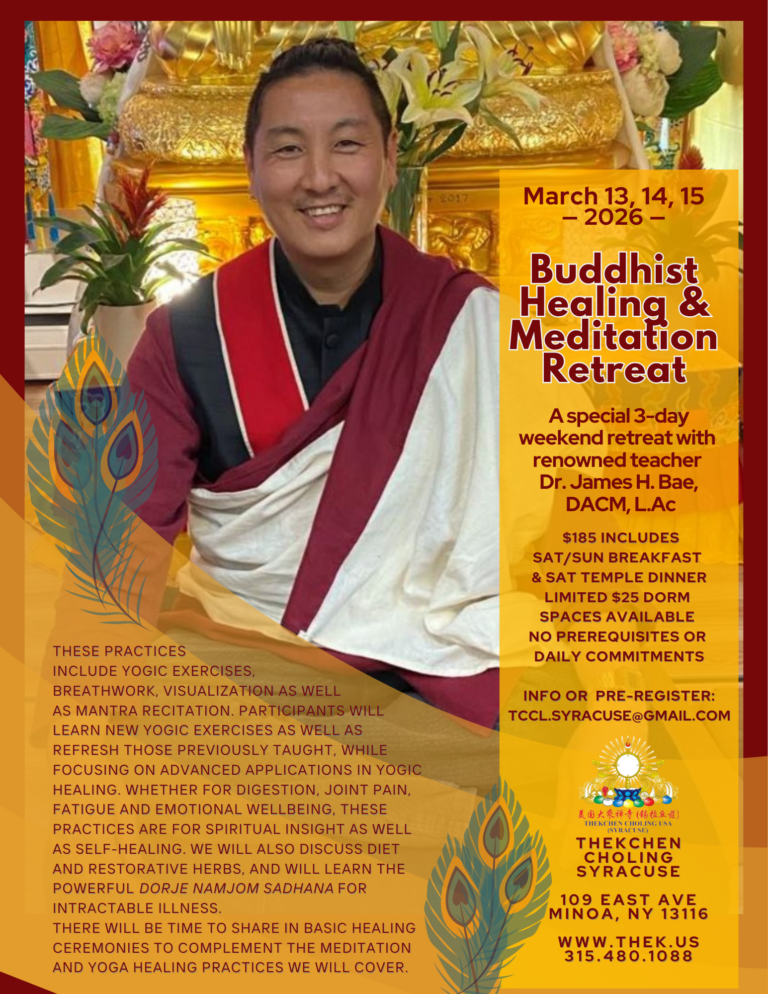
Dr. James Bae Leads Weekend Healing Retreat at Thekchen Choling Syracuse, March 13-15
World-renowned Tibetan yoga master to cover ancient healing methods, purification practices, and restorative diet and herbs.
Dr. James Bae, a world-renowned master of Tibetan yoga and Tsa Lung yogic practices, returns to Central New York for a weekend healing retreat.
He will lead a program titled Tibetan Yoga, Meditation and Buddhist Healing Methods at Thekchen Choling Syracuse (109 East Ave., Minoa) on March 13-15. The retreat runs Friday night, all day Saturday and Sunday morning.
Open to adults of all ages, backgrounds and physical abilities, the retreat costs $185 and includes Saturday and Sunday breakfast as well as a Saturday night dinner. Simple, dormitory-style lodging is available onsite for $25 a night on a first-come, first-served basis.
To register, contact temple president Babette Teich-Visco at tccl.syracuse@gmail.com or 315.480.1088. The registration deadline is Sunday, March 8, at 5 p.m. (ET).
Teich-Visco considers “Dr. James,” as he’s affectionately called, one of the temple’s most popular presenters. “He’s an expert in his field,” she says. “In spite of his impressive credentials, Dr. James presents mind-body medicine in a relaxed, accessible way.”
Bae will teach students how to integrate their body, mind and spirit—a 2,500-year-old practice dating back to the time of the Buddha. Special emphasis is on various healing methods, like Tibetan yogic exercises, breathwork, visualization and mantra recitation, as well as restorative diet and herbs, some of which Bae has acquired on a recent trip to Asia.
He also will present a simple, yet powerful practice based on Dorje Namjom, a Vajrayana Buddhist deity specializing in cleansing, purification and the elimination of negative karma. Dorje Namjom is part of the Nyingma tradition, the oldest of the four schools of Tibetan Buddhism. The practice treats a wide of range of illnesses, from intractable pain conditions to neurological and psychiatric disorders.
“All of these methods ultimately foster spiritual insight and self-healing,” says Bae, a licensed, U.S.-trained physician in acupuncture as well as Chinese and Ayurvedic medicine.
Much of his work is rooted in traditional Buddhist theories, like Interdependent Origination, which suggests that all sentient beings are interconnected, and the law of cause and effect (aka karma), underlying the practical understanding of how disease, illness and suffering arise.
The idea of a bodhisattva—an enlightened being who, instead of entering Nirvana, remains in the cycle of death and rebirth to assist others—also informs his teaching.
“Buddhist healing begins and culminates in a place of compassion,” says Bae, a Brooklyn-based medical clinician whose expertise extends to trauma-informed approaches to Tibetan yoga and to Tsa Lung, which uses breath retention, physical movements and visualization to clear energetic blockages in the body’s subtle channels.
“The wisdom of our interconnectedness informs Buddhist Yogic healing methods,” he adds.
Thekchen Choling Syracuse is the North American seat of Singha Namdrol Rinpoche, a Vajrayana Buddhist lama who has founded centers in Malaysia and his native Singapore. Located in the picturesque village of Minoa (a suburb of Syracuse), the 11-year-old temple is home to two resident monks, weekly events and activities, and a collection of Buddhist relics.
Thekchen Choling also offers an online portal, through which people can request pujas and light offerings for all kinds of healing and purification. The portal is available at https://thekchen-choling-usa.square.site/.
THE WHEEL OF COMPASSION:
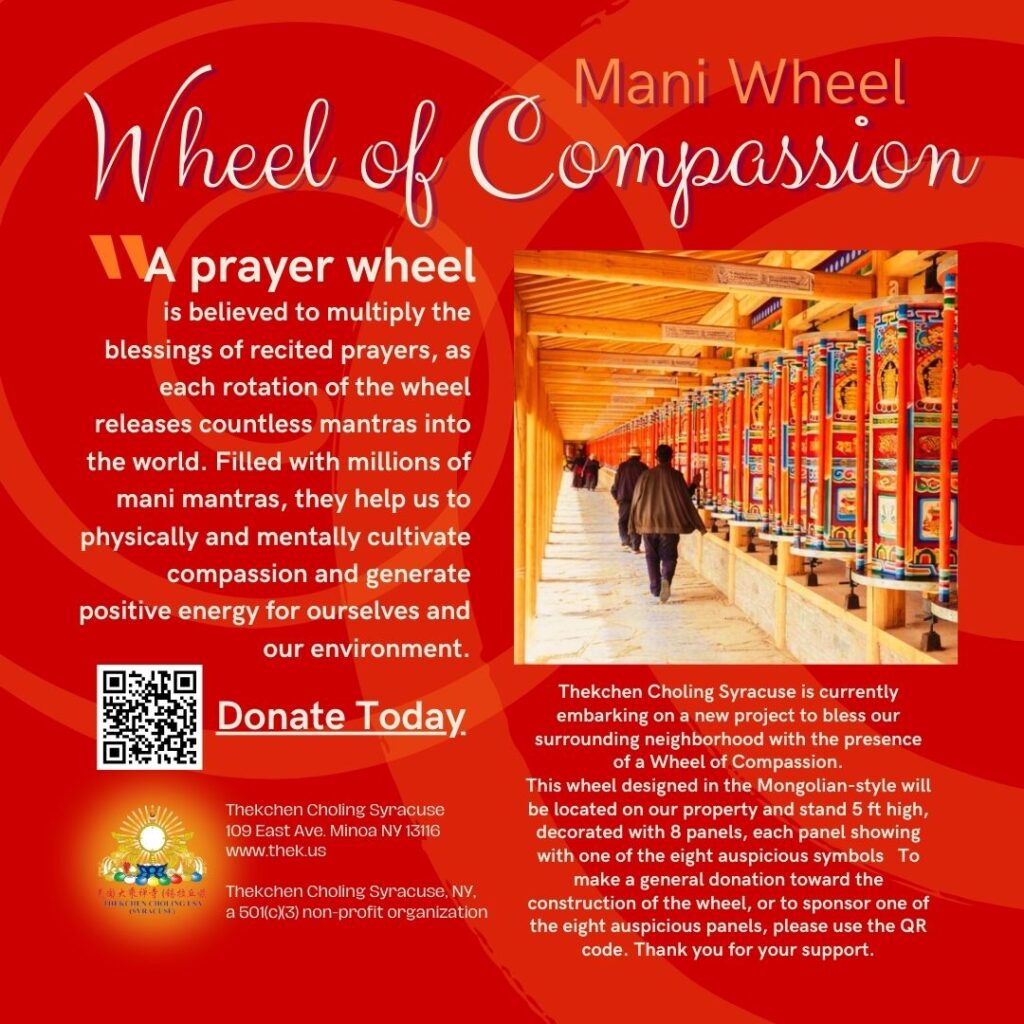
A prayer wheel is believed to multiply the blessings of recited prayers, as each rotation of the wheel releases countless mantras into the world. Filled with millions of mani mantras, they help us to physically and mentally cultivate compassion and generate positive energy for ourselves and our environment.
Thekchen Choling Syracuse is currently embarking on a new project to bless our surrounding neighborhood with the presence of a Wheel of Compassion. This wheel designed in the Mongolian style will be located on our property and stand 5 ft high, decorated with 8 panels, each panel showing with one of the eight auspicious symbols.
Through your donation you can help Thekchen Choling Syracuse realize our goal of the construction of this sacred wheel to benefit all sentient beings. To make a general donation toward the construction of the wheel, or to sponsor one of the eight auspicious panels, please scan the QR code or click below
The Suggested Donation is $1,000
https://thekchen-choling-usa.square.site/
The Eight Auspicious Signs/Symbols
These Eight Auspicious Symbols of good fortune represent the offerings made by the gods Brahma and Indra to Shakyamuni Buddha immediately after he attained enlightenment. The Eight Auspicious Symbols are: the parasol, the golden fishes, the treasure vase, the lotus, the right-spiralling white conch shell, the endless knot, the banner of victory and the wheel.
The parasol represents the shade, or protection from the heat of suffering, desire, obstacles, illnesses, and harmful forces. The golden fishes symbolises happiness, freedom, fertility and abundance due to their rapid reproduction. The treasure vase attracts wealth and brings harmony to the environment, filled with wish-fulfilling jewels. The lotus is the symbol of absolute purity, it grows from mud but is unstained by it, free from defilements, emotional hindrances and obscurations.
The white conch shell is a symbol of religious sovereignty and an emblem which fearlessly proclaims the truth of the dharma. The endless knot symbolises the Buddha’s endless wisdom and compassion, denoting the interdependent origination as the underlying reality of existence. The victory banner symbolises eleven methods of overcoming defilements, such as skilful means and selflessness. Lastly, the wheel symbolises Buddha’s teachings and spiritual transformation, to overcome all obstacles and illusions.